skip to main |
skip to sidebar
Collision detection needs to be calculated, as the ball contacts and needs to rebound from the borders around the game board, the paddle and the bricks.
This works on the physics equation:
speed=distance/time
To calculate the movement of the ball after collision I need to know how much time it has taken to reach the collision, as a proportion of a time step. The remaining time in the time step after the collision is used by the bal l travelling in the opposite direction.
x1=ball position x – minimum x + ball radius //calculate distance ball travelled before collision

t //amount of time step as proportion, between 0 and 1
y1 //distance travelled in y before collision
velx //total distance moved (real and projected) in x in time step
vely //total distance moved (real and projected) in y in time step
t=x1/velx //distance travelled in x in proportion to whole distance to be travelled in time step
y1=t*vely //calculate distance travelled in y before time step, multiply whole distance the ball would travel in time step by proportion already travelled
velx=-velx //reverse direction
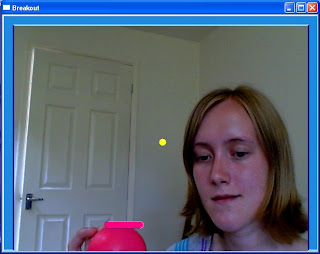 The design ideas for the ball and testing suggested that the ball should be yellow, to ensure that it stands out against the background of the game board, the video image of the players.
The ball has the same diameter (in pixels) as the height of the paddle, to keep continuity and for aesthetic purposes. A small white rectangle has been added to the yellow ball to create a pseudo 3D effect and add detail to the ball.
The ball has been coded to move only within the borders of the game board. This required some mathematical work, to calculate the velocity of the ball, it's projected position from an initial state to the next during one time step, the distance the ball travels in the x and y axis in a single time step and when it should rebound from the border, accounting for the radius of the ball.
 l travelling in the opposite direction.

